I bought my first digital camera in 1999. It was a two megapixel Olympus that recorded onto the now defunct yet surprisingly slim SmartMedia cards. Being some 26 years ago, my memory is a little hazy but as I recall, it shot jpeg and tiff file formats.
The tiff format was significantly larger and with the SmartMedia card I owned, I couldn’t save much more than about 8 shots. So, jpeg became my image format of choice, along with most other adopters of digital photography.
Roll on 26 years, and we still have predominantly two image file formats on our cameras, jpeg and raw. Raw has pretty much replaced tiff due to its much greater latitudes to editing. However, jpeg remains a file format developed long before the advent of digital cameras.
Things, however, are changing and is often the case these days, it’s being driven by smartphones. So today we are going to try and make sense of the current image file formats, hopefully allowing you an informed view on which one to use in your photography.
Jpeg – The Grand Daddy Of Formats.
We all know jpeg. It’s been around longer than many of us have been taking photos. But why has it been so enduring? The simple answer is file size. Jpeg, being a compressed format, enables not only many more images to be recorded to a card, but for them to be recorded quicker.
The computing power in modern cameras, combined with the size of memory cards means this is not a major consideration these days. However, for the first, perhaps, two decades of digital photography, speed and space were very much technical barriers. So the jpeg endured.
Even today it has plenty of uses. Much of the image data, white balance, saturation, contrast, etc., is baked into the file, meaning it requires much less editing.
Its small file size still gives advantages today when shooting large number of shots, very quickly, such as in sports or wildlife photography. Jpeg is not going away anytime soon. Or is it?
As mentioned earlier, smartphones have driven a lot of recent photographic technology. However, being multi purpose devices, their processors are not dedicated entirely to photography. They also have limited internal space and are capable of “on the fly” computational photography. All this adds up to needing a very small, very “fast to write” file format.
Enter, HEIC or HEIF, High Efficiency Image Container or Format. Developed by Apple and some Android manufactures, it has fast become a staple of smartphone photography. However, it is now making its way onto more mainstream, mirrorless cameras as an alternative to jpeg.
The main thing that has been holding the format back has been software. Being Apple developed, Macs have been able to deal with the format since the beginning, however, Windows has only recently started to support the file natively. All this added up to a relative lack of editing software to process these files. That, however, is changing fast and I suspect we will soon see cameras replacing Jpeg with HEIC rather than supplementing it.
Like jpeg, however image data, including computational photography data is backed in. This means it is not as editable as a RAW file. Speaking of which..
RAW – The Digital Negative.
I can’t remember exactly when raw first started to make an appearance in digital photography but I suspect it was the early 2000s. It was a dramatic entrance, more a subtle realisation that there was a format that allowed us a lot of editing leeway and to change white balance in post production.
It was not without some major issues though. These days we simply drop a RAW into Lightroom and get to work. In the early days however, you needed dedicated RAW editing software, making for a complicated and expensive workflow.
RAWs look very flat straight out of camera but reveal the most detail. By Jason Row Photography
Today however, raw is the gold standard. It is by far the most malleable file format, yielding the highest image quality. Technically raw is actually many different file formats, each camera manufacturer has a raw format, and individual camera models can have variations on that raw format. Adobe even has its own raw, dng, which allows for you to convert your OEM Raw file into an all encompassing, generic raw.
It’s not without issues though. It’s a much larger file size than jpeg and HEIC and straight out of the camera the images are very flat and unsaturated. They are, in effect, digital negatives that require you to work on them to get the best results.
Raw files can also come in uncompressed, lossless compressed and compressed formats, adding to the confusion. Unless space is at an absolute premium, uncompressed is the way to go.
Early adopters of new cameras can also come up against issues, where Mac/Windows or editing software developers have not had time to add the new raw file to their systems, leaving photographers without a way to edit their raw files.
However, it is probably safe to say that raw, in its many different forms will be the de facto format for the years ahead.
Whilst jpeg persists and raw reigns, camera companies and phone developers are not standing still. There will be new formats in the future, some of which we are beginning to see now.
Apple’s ProRaw is a relatively recent file format, which on the face of it is a vanilla raw file. However, it is actually a combination of raw and HEIC. This allows for some of the editing leeway of a RAW file whilst incorporating the ability to use computational photography at the time of taking.
The jpeg file format has also gone through a re-imagining in the form of jpeg XL. This is a new variation of the format, that offers higher compression, smaller file sizes but with a much improved image quality. In its lowest compression it offers lossless image visual image quality.
Beyond cameras there are also new image file formats designed for displaying images online but give a much better quality than jpeg or png.
Like VHS/Betamax there will probably only be one dominant compressed file format, whether that is HEIC or jpeg XL remains to be seen.
For now, though, your main choice on mainstream cameras is jpeg or raw. Raw will give you more editing ability, and better image quality. Jpeg will allow you to shoot faster and edit less.
Any new future formats will probably still fall broadly into those same two categories, it will always be quality vs convenience.
My best photographs are usually a surprise to me. Long after I’ve made them, they feel familiar and almost inevitable as I look back on them, but not one of them could I have really ever anticipated at the time. The light, the composition, even the subject—I often never see them coming. Sometimes, the surprise is that the image even worked at all, as is the case with my image of a common merganser in flight against golden water.
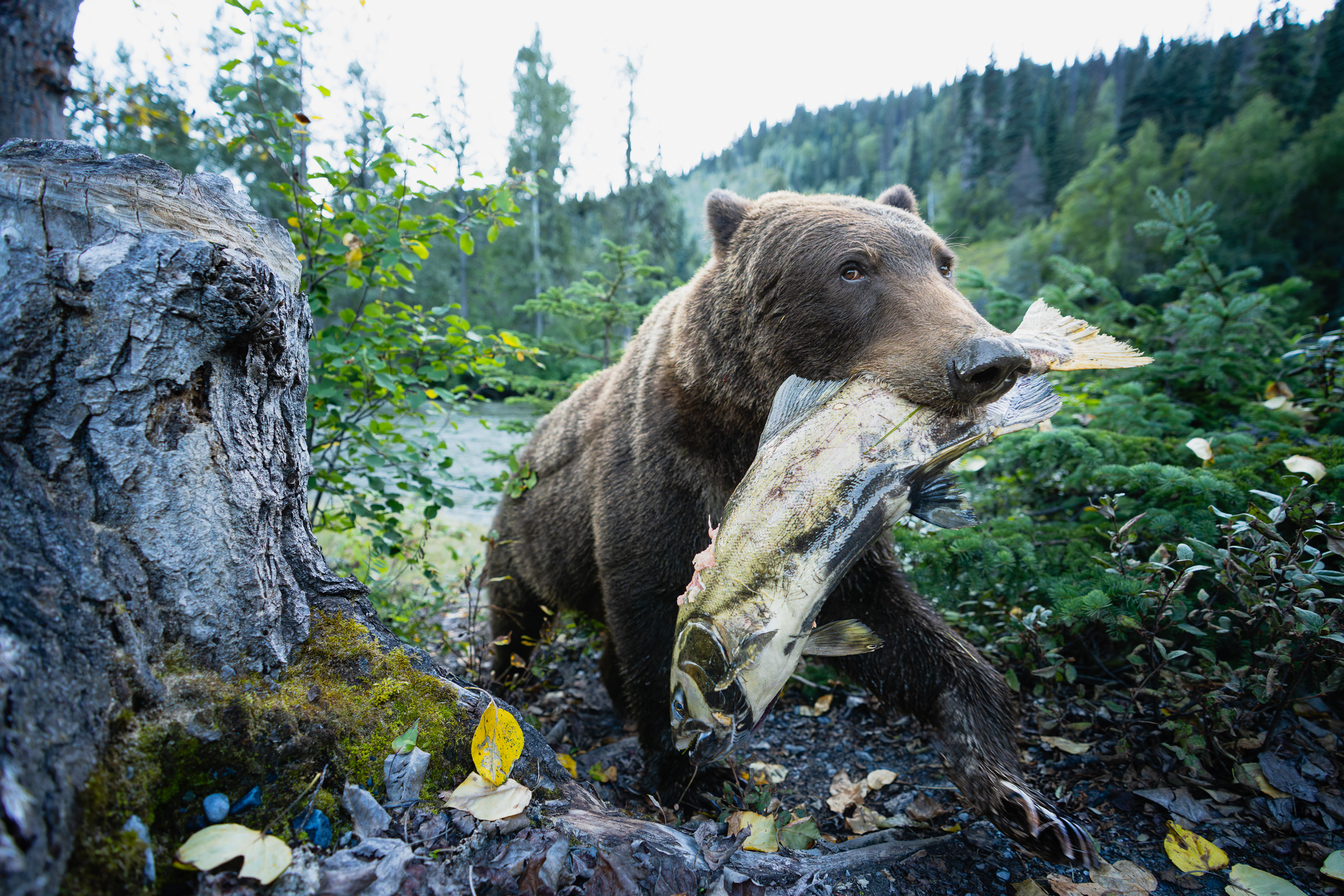
Last week I once again found myself sitting on the banks of a northern river—the aspens just starting to turn gold, the air full of the smells of autumn. I was there for three short days to photograph grizzly bears, and while I came home with a couple of photographs I love in which a bear is the star of the show (below), the one I am most in love with, and surprised by, is my golden merganser (above).
A grizzly bear takes his prize of a spring salmon (also called a chinook, or king salmon) into the forest to eat in peace. I made this image by triggering my camera remotely while watching from a respectful and safe distance.
Back to the merganser. The simple version of “here’s how I made this photograph” is this: 1200mm (600mm + 2x), 1/30s, f/10, ISO 125.
But that’s not really a “how,” is it? That’s the math, but it’s not the method.
To begin with, this was supposed to be a photograph of a bear; that’s why I was there. But in this moment, the bear had chosen to be elsewhere, ignoring (not for the first time) the art director whose directions about the art had been clear: be there. He wasn’t. While I waited there, the river rushing past me, I had time to look around and really take things in. A patch of river to my left caught my eye, the reflections of the aspens turning the otherwise silty water a beautiful gold. The odd merganser (but then all mergansers are a little odd, are they not?) would drift through that water, and eventually I turned my lens towards them.
Mergansers are weird little diving ducks. They bob and weave through the water, ducking below the surface to fish before coming up and thrashing around and flapping their wings in something that looks like a bit of a ritual and a little bit like a seizure. Drying off (or showing off), they’re goofy little creatures, and if you watch them long enough, your indifference towards them can turn to fascination, even affection. And I don’t say that lightly because I am not (emphasis heavily my own, and a little defensive, which is hard to show with italics) a birder. I digress.
It was in one of these moments of fascination, the bear long forgotten (but seriously, where was he?), that it occurred to me that my efforts to photograph these birds were not stirring my imagination. They were still just ducks on the water, and the behaviour that most interested me was translating poorly into a photograph at 1/1000s: just very sharp pictures of ducks.
There was something there—I could feel it—and I had nothing but time to try to find it. I also had nothing to lose. To say I wasn’t invested in the pictures I was making would be an understatement, and that was probably part of the problem. I simply didn’t care. There was no challenge. Just a bored photographer making boring pictures.
For a moment, I turned my attention to the moving water, spun the shutter to 1/30s, and started playing with the shapes and colours as blurred by the slow shutter speed. There was something magical in that. I know, it should have all been so obvious to me, but it took a while to shift my thinking from the literal to the more creative. Now I needed a merganser in that moving water!
It is not uncommon for my photographs to improve dramatically when I finally say “f*ck it!” and start to play, to experiment with my process with no real concern for the resulting image. It’s a shame I can’t get there faster, but it seems necessary for me to pass through the boredom and the “nothing else is working” first. By the way, I’m trusting you to keep this to yourself: I’m pretty sure the “real photographers” out there can jump straight to the part where they make brilliant images, but that’s never been my path, and I would hate for them to find out just how defective I really am.
I’d like to now explain the magical thinking that ultimately led me to make this image, which I am very much in love with, but I can’t. That’s usually what happens when you’re playing. One “let me try this” leads to “that didn’t work at all” which leads to “hey, this might be cool!” and somewhere in there I saw one of these daft birds taking off, which is a hell of a process and exhausts me just watching it, so I panned with it in a wild “this will never work.” And that’s when the magic happened.
No it didn’t. Not even close. It was a disaster. It didn’t work at all. Some frames were just a little blurry head sticking into the frame; others were nothing but tail feathers, also very blurry. Sh*t! Sorry, I say salty words when I play and start to get too invested in the results. But I saw something I liked. A glimmer of hope. So I tried again. And again. And after years of talking about panning and knowing exactly how to do it (even pulling it off once every couple of years or so), one of the frames was good. It made my heart leap. Not perfectly sharp, but that wasn’t really the point. Perhaps perfectly sharp would have ruined it, I don’t know. To me, it was poetic, and that’s better than perfect. To me there’s an echo of Robert Henri’s “paint the flying spirit of the bird, not its feathers.” I loved it, and there was no “I love it, but….” Just that giddy feeling you get when you make something that thrills you—something that feels like magic.
For those of you who skipped to the end: I just used a long lens, a slow shutter speed, and panned with the duck. Easy peasy. 😉
For the Love of the Photograph, David
Save 50% on all Craft & Vision eBooks – Last Chance!
For those who haven’t been following the major rift in the world of photojournalism a quick summary of what is going on: A film called “The Stringer” directed by Bao Nguyen (previously directed The Greatest Night In Pop) and produced/starring Gary Knight (VII Agency co-founder and ED) premiered at The Sundance Film Festival on January 25 claiming and attempting to prove that 53 years ago Nguyễn Thành Nghệ actually took “The Terror of War” (AKA Napalm Girl) image and not Nick Ut. AP photo editor Carl Robinson claims his boss, Horst Fass, told him to switch the credit from Nguyễn, a stringer, to Nick, an AP photographer. The filmmakers find Nguyễn, and he says, yes, he took the picture.
Prior to the film’s premiere, the AP released a preliminary report disputing the claims of the film. At the premiere, the AP watched the film and followed up (May 16) with a 100-page report saying that there’s not enough evidence to remove Nick Ut’s credit.
Then, on May 16, World Press Photo released a statement saying they investigated (David disputes the characterization that they investigated and rather they simply got a private screening of the film and agreed with the conclusion) and are suspending Nick Ut’s credit on his 1973 Photo of the Year award.
This sparked outrage on social media with posts from what appears to me to be the VII camp (Ashley Gilbertson, Ed Kashi, Sara Terry) and the Nick Ut camp (David Burnett, Pete Souza, David Kennerly).
And the real zinger in the whole dust-up is that David Burnett was there! He’s an eyewitness to the events at Trang Bang, where the famous image was made.
Ok, one final note: besides the premiere at Sundance and private screenings, the film cannot be watched until a distributor is lined up. I’m aware of a screening in DC next month, but most people, including David and myself, have not seen the film.
I talked with David over the phone, and here’s a condensed and edited version of our conversation.
Screenshot from AP Report: Investigating claims around ‘The Terror of War’ photographScreenshot from AP Report: Investigating claims around ‘The Terror of War’ photographScreenshot from AP Report: Investigating claims around ‘The Terror of War’ photographScreenshot from AP Report: Investigating claims around ‘The Terror of War’ photograph
Rob Haggart: I want to start by asking if it’s really difficult for you to go back and rehash all this stuff.
David Burnett: No, I mean, I have these moments from not just Vietnam, but the jobs that I worked my whole life, French elections, Ethiopia, Chile, and it’s not really something that causes me great pain. There are so many of these things that I’ve lived through that the memories of them and what I was doing in them as a photographer is very, very clear in my head. And Trang Bang is really no different than almost anything else.
The first time I was under fire and had the crap scared out of me, it’s one of those things where you don’t just think, will I ever get over it? Because you don’t, they become part of what your life is about.
The running joke about Trang Bang and me was that, well, I missed the shot because I was changing film in my old screw mount knob wind Leica which is kind of a slow, kludgy film camera. It was not an easy camera to operate.
And yet, Cartier-Bresson shot with them for something like 20 years before the M2 and the M3 came along and made some pretty great pictures, so I mean, I think part of why I even bothered shooting with that camera instead of getting another M2 for 200 bucks, was kind of a historical thing with the old Contax and Leicas, you felt a little more attached to some kind history if you’re shooting with this kludgy old camera and um you know, and I was trying to reload it and anybody had ever owned one of the cameras knows that if you take a 35-millimeter film where you have the little cut-down tongue that you really need to cut an extra inch or inch and a half away from that one side that’s cut so that when you drop the film in the camera, it will seat itself perfectly.
I never bothered doing that, so I was always stumbling, trying to get the camera reloaded. So I was reloading it when the plane came in to drop the napalm. I was holding the open camera in my left hand and shooting with a 105 in the other hand. When the napalm hit right next to the pagoda, there was this Gigundo fucking fireball, Nick has that picture, and I kind of have it a few seconds later. But it was the in the days when you didn’t shoot with three motor drives, you know, you weren’t going out there to shoot 25 rolls of film. I think I shot maybe three or four rolls that day, and it was a fairly long period of time we were there because we were kind of hanging out waiting to see what was going on.
You could hear firing and shooting coming from the village. Then the planes came in, and there was that fireball, and then like three minutes later, the kids started running out of the field and onto the road toward us, and that is the moment, more than anything in my mind, where Nick was the one guy who was in a position to shoot the picture, and nobody else was. There was this line of journalists, and we were all within a few feet of each other lined up across the road. As soon as we could tell that, there were people on the road racing out toward us, and the kids were running as fast as they could run. Nick and this guy Alex Shimkin, who was killed a few weeks later up north, took off running towards them, and no one else did.
RH: When did you first hear a film was being made about this event and that there were questions about the author of the famous image?
I was sitting at a Walgreens parking lot in Florida 3 years ago going in to go get some stuff, and Gary Knight called me and said tell me everything you know about Trang Bang, so I spent a couple hours on the phone and told him everything I know and then said you know there’s this guy and he’s kind of a horses ass, ex AP guy and he says that Nick didn’t shoot the picture and I kind of think he’s full of crap as does everyone else but along the way you’re gonna run into Carl Robinson.
Carl had this real chip on his shoulder about AP, and he was never afraid to let people know how he felt like he’d been screwed over by the AP.
RH: So you’re telling me this rumor has been around for a while?
Yep, a long time. It’s not new. The last time I saw Horst Faas was in 2008. There was a gathering for a memorial wall at the news museum in Washington, and if you lived near the East Coast and worked as a journalist in Vietnam, you pretty much were there that day. Somebody at that point could have said, hey, Horst, let me talk to you about this thing that Carl’s been telling everybody that you told him to put Nick’s name on the image, and it was really some stringer’s film.
And no one ever, no one ever asked Horst.
No one ever just asked him point blank.
I guess Carl makes a pretty reasonable case for trying to talk about how the guilt of 50 years and being able to unburden his guilt when he finally met this guy. But you know, every crackpot theory that ever was has at least a 2% chance that it happened.
Could Horst have said it? I suppose he could have. But it would have been very out of line with what always happened.
If you talk to Neal Ulevich, who was in the AP bureau as a staff photographer for, I don’t know, six or seven years in Asia and was in the bureau the whole time, he will tell you about the sacrosanct policy of never allowing anyone’s film to have any name on it other than the actual photographer that shot it.
He said, “All the time I was in Asia, never once did I see anybody do anything like that.”
It just didn’t happen.
I was in that group of people who were looking at the first print of Napalm Girl when it came out of the darkroom, and I did what every photographer in the history of photography would have done, which is I look at this picture and I try and think to myself without having seen my own film, hm, I wonder if I have anything better. I’m thinking, yeah, that’s pretty good. That’s probably better than anything I have.
There were 3 or 4 of us looking at this little 5 x 7 print that was still wet, and Horst, without making a big deal out of it, just turned to Nick and said, “You do good work today, Nick Ut.”
I still have the memo I wrote when I went back to my office at the Time-Life Bureau. I said there was this accidental bombing in this village called Trang Bang, and I said, Nick from AP got a pretty good picture, and they tell me they’re shipping the negative to New York on what’ll be the same flight that my negatives are gonna be on, so you’ll be able to get an original print made in the lab rather than rely on a wire service photo.
So that’s what they ended up doing. It was in the front section of the magazine called the Beat of Life; there were always 3 or 4 of these big picture spreads.
Usually one picture, sometimes two or even three, and they ran one of mine of the grandma with the burned baby and Nick’s picture side by side, and when you look in the photo credits, it says page four and five, David Burnett, AP. I mean, it was the wire services in the 70s. They weren’t going to put a photographer’s name on it. It’s kind of funny that way.
RH: What are the chances, if you’re Nick, that you don’t know beforehand you made that picture?
There’s no way that either of those guys would not know they took that picture. It was such an enpassant moment, and I’m sure there was just one frame that was the one.
For sure, there are times when you’re surprised by something you’ve done when you move from wherever you shot it, and now, you know, we’ve kind of shut out the middle man, and you go right to the computer and see if what’s on there is anything like what you remember, but in the film days I would find it really hard to not know that you had something.
I can’t imagine that the camera wasn’t up at the eye; it’s not like a chest-high Hail Mary, although technically, it was never great, but maybe at the same time, some of the imperfections add to the raw reality of that moment.
RH: That leads me to this talking point I see from the film’s defenders saying that this is not a critique of Nick, but that would mean that Nick didn’t know he took the photo. But you think there’s no way he didn’t know he took the photo, so the film is saying he’s been lying for 53 years about this.
He’s a 21-year-old kid with a camera, and I think incapable of that. Yes, it was a good picture, but there were a lot of good pictures out there.
And, you know, some people have said, oh, but Horst knew right away that that was gonna be a great picture, and he wanted AP to have the copyright on it instead of a stringer. But the thing is, you’ve got all these little sub-arguments if you accept a certain premise, and you can walk yourself right off a cliff of trying to figure out what it is you believe or don’t believe.
Gary called me back at one point, and he said, you know, I think there’s really something to Carl’s statement here, but you know, once you get the first bit of the Kool-Aid, you just gotta drink the whole pitcher, and I just don’t see it.
I mean, like I said, it’s possible.
Everything’s possible, you know?
I mean, you know, once you start to believe part of it, you kind of end up believing the whole thing, or you believe none of it.
To me, it looks like Gary’s trying to make himself into a big documentary producer, and this is his launch pad.
Gary said you ought to be in the film, and I just said, Gary, I don’t wanna do a goddam Mike Wallace interview where I have no control over how you cut it or anything else. I’ve watched 60 minutes too many times where Mike managed to hammer somebody, and I had no confidence that it would be a fair representation.
Fox Butterfield was the reporter I was with that day working for The New York Times, and he got a call from Gary’s wife, a producer on the film, he started to tell her his version of what took place, and she told him everything you’ve said is wrong. That’s not a really good way to coax people into a discussion. She said he would have to sign a non-disclosure agreement, and he said, what the hell for? I’m the one telling you stuff; you haven’t told me anything.
Gary said to me last time I talked to him like six weeks ago, he said, well, you know, we’ve done all this forensic stuff, and we’ve proven that he couldn’t be down there to take the picture.
And I said to him, in my mind, because I remember the way he ran out on the road ahead of everybody else when the kids were coming down the road, he’s the only one who could have taken that picture because it was in the very first moments that the kids were coming down toward where the journalists were lined up, and it was after that everybody else started wandering around, but that was another five or ten or 15 minutes later.
And I just don’t see how anybody else was out there in front, and to me, that picture was taken out in front. It wasn’t taken right next to the press people.
It was out there away, maybe, I don’t know, 20 yards, 40 yards. 50 yards.
RH: How do you think the filmmakers should have handled this? What should they have done with the information they got from Carl?
You don’t ever want to get to a place where people are afraid to posit things, but I don’t know what the answer is, but you know, unlike a lot of people who don’t shut up about it, I’m not sure I have an answer to what the most perplexing question is.
And I never said I was right behind him when he shot that.
I saw him, I was changing my film, and it was a minute or two minutes later, and in those moments, that could be a long time. I offer it strictly as a witness to what happened that day and nothing more.
I find one of the most curious things of all, aware of the fact that Nguyễn probably had to leave Saigon with almost nothing, that he left everything behind, andI totally get that.
But apparently, he never sold another picture to anybody, and in the last 50 years, no one has even seen one picture that he’s taken.
Other than the most famous picture of the Vietnam War.
ChatGPT’s new image-generating tool is causing more than a stir in the artistic and legal communities.
An abstract image of a sphere with dots and lines in the shape of a brain. Photo by Growtika
It has also gotten the attention of massive names like Adobe and Figma. In fact, those two platforms, among others, will be integrating this ChatGPT feature into their workflows going forward, giving millions of users access to some of the most powerful image-generation tools out there.
If this seems like just the beginning, you’re not the only one. We’re not surprised to see this happen, but we thought that these platforms would probably want to have more control over the service (that is, you know, make their own image-generation tools which they are but I guess when you see the best, you know it).
ChatGPT’s blog post about the integration shows off some of the work from the major platforms which include the aforementioned Adobe and Figma as well as Airtable, Gamma, HeyGen, OpusClip, Quora, Wix, Photoroom, and Playground, among others.
And the tool will focus on a unique area for each platform. For example, GoDaddy will be taking advantage of the logo-generating abilities of the platform to help its users create easy, editable logos, ChatGPT writes.
Interestingly, one use case that is listed is Instacart which, unlike the others, will be used to help generate shopping lists and suggested recipes for customers which gives us all some idea of the depth and breadth of possible uses for ChatGPT’s AI.
Naturally, how it got this talent this fast continues to be a source of debate, particularly in Japan if you missed our story from earlier this week.
Have you tried out ChatGPT’s image generation tool? Let us know your thoughts on it in the comments.
We have some more news for you to read at this link.
I mostly use Lightroom CC Classic as my daily choice. The AI tools inside Lightroom are powerful, and I often use the masking panel to create selections and fine adjustments. Occasionally, when I need to do some heavy editing, such as removing a difficult part from an image, I turn to Photoshop. The Content-Aware Crop is brilliant for adding more sky to a picture if cropped too tightly. Or, if I need to have more flexibility with layers, Photoshop is an excellent choice.
For experimenting with a photograph or when I feel too comfortable with editing, I use Luminar Neo. I can easily step into a beginner’s mindset while working with it. And finally, my go-to sharpener at the moment is Topaz Labs Sharpen AI, which does an excellent job when I need to add sharpness to my images. Also, GigaPixel AI is fantastic for ensuring my photographs look brilliant when printed.
AI image editing tools can significantly improve your landscape photography editing process. By using Lightroom, Photoshop, Luminar Neo, and Topaz Labs, you can achieve beautiful results and bring your creative vision to life. While these tools are powerful, they may have some flaws, so finding the right balance and workflow that suits your needs is essential. I recommend exploring and incorporating these tools into your workflow to enhance landscape photography.
Unlock Your Creative Potential
As you delve deeper into the world of AI-powered photo editing tools and unleash their potential, consider exploring some of the resources I’ve created to help photographers at all levels improve their skills and find inspiration.
The Complete Photography Collection. This all-inclusive package features all of my tutorials, presets, and eBooks, offering a comprehensive guide to enhancing your landscape photography and achieving the recognition your photos deserve.
Epic Preset Collection. Transform your editing process in Lightroom with my presets to help you unlock your creative potential and bring your images to life.
1-on-1 Photography Coaching. Whether you’re a beginner or an experienced photographer, my new online 1-on-1 coaching service is designed to provide personalized guidance and support to your needs and goals.
Free Tutorials. For those just starting or looking to expand their skills without breaking the bank, check out my collection of free tutorials covering various aspects of photography and editing.
Remember that AI is a tool; like any tool, it can’t replace the human element in the creative process. Embrace your intuition, emotions, and experiences as a photographer, and let them guide your editing choices. This will help you create images that not only look interesting but also resonate on an emotional level.
Your personal style and artistic voice are what makes your photography unique. While AI tools can help you achieve technical perfection, preserving your creative identity and ensuring that your images reflect your personal touch is essential.
Let me know if you use any of these tools or want to try them out. Thanks for reading!
Disclaimer: I’m an affiliate of some of these programs. Remember that using the affiliate links in this article helps support my work and enables me to continue sharing my experiences and insights with you.
In honor of Earth Day, National Geographic is offering the chance to feature your best nature-themed image on their “Your Shot” Instagram page. The event is being pitched as less of a formal competition and just a great way to honor the best wildlife photography on the planet, for the planet.
The process is easy: Just post an image using the hashtag #NatGeoYourShotOurHOME between now and April 22nd. Prolific filmmaker Bertie Gregory and a handful of Nat Geo editorial staff will select their favorite shots and share on the Your Shot Instagram page on April 30th.