برچسب: Change

  • Change Your Lens, Or…?

    Change Your Lens, Or…?

    [ad_1]

    Imagine this: we’re side by side at a local pond, a thermos of coffee between us as the first light comes up. You’ve got your camera with a 24-105mm lens. I’ve got mine, too, but chose to bring my 300mm lens instead. As we set up, you say you wish now that you’d brought a longer lens. 

    “Funny,” I say, “I was just thinking the same thing,” though I was wishing for something shorter.

    How many times has this scenario played out for you? You make choices, bringing one lens only to wish you had something else. If you have 400mm, you want 600mm, and if you have 600mm, you want 24mm. And just knowing that can make the choice painful, even paralyzing.

    But here’s what I know: whatever you bring, you will make something of it, because that’s how creativity works.

    Creativity works with what it has. What you lack will always force a constraint upon you and (here’s the benefit) force you into looking at the scene in a new way.

    If we’re walking through the streets of Venice and I have a telephoto lens and you have a wide-angle lens, we will look for different things and see different possibilities in the very same scene; we’ll see in different ways because of the gear, not despite it. I will be looking wider, taking it all in, trying to find order in the chaos. You will be looking for tighter scenes, scenes that play well when compressed and cropped tight.

    The lens you have will force you to say no to photographing some scenes in ways to which I am eagerly saying yes, and vice versa.

    Back to the pond. We’ve settled down in the grasses, still wet with dew, and just as the first licks of that golden light hit the pond, a loon emerges from the reeds, probably flushed out by our presence, and we both raise our cameras. The loon takes off, a belaboured affair with a lot of splashing. You, having accepted your limits, photograph the whole pond, shrouded in fog, the loon only a detail in the larger image, which will tell a bigger story than what I’m making. My image is much tighter and you can see every drop; there’s detail and mood, and it says both less—and more—than your photograph. The images are so different from each other. Not necessarily better, or worse. Different.

    This same scene plays out in similar ways, minus the loons, on every safari I lead. You will not bring the same gear I brought, and vice versa. But we’ll both make something of it, and probably something wonderful, so long as we’re not sidetracked or distracted by our constraints, but allow them to help us see in new ways.

    It is usually (maybe always) easier and more productive to change our thinking than it is to waste that energy wishing we could change our lenses.

    If we’re willing to have this conversation with it, the gear we have says, “OK, you have what you have: long, wide, fast, slow, whatever. What are you going to do with it?” It’s an invitation to see differently. The bear is too close, and all I’ve got is my stupid 600mm! Maybe now’s the time to isolate the details in the claws, or explore the textures of the fur. Maybe it’s not about the bear at all, but the salmon in his mouth.

    I don’t know what you photograph or what kind of gear you’ll have with you as we sit together, but I do know I’ve yet to find the scene that has only one way of looking at it, or a scenario where there isn’t a dozen ways to photograph.

    I wonder how our perspective would change, or what kind of energy we’d bring to our work, if we gave as much thought (or more) to the different ways of looking at a scene than to the gear we choose. Different gear means different possibilities, but eventually, we hit the limits of those choices. Accepting this—and embracing it—is a way forward into greater creativity.

    You can’t always change your gear, but you can always change your thinking.

    For the Love of the Photograph,
    David

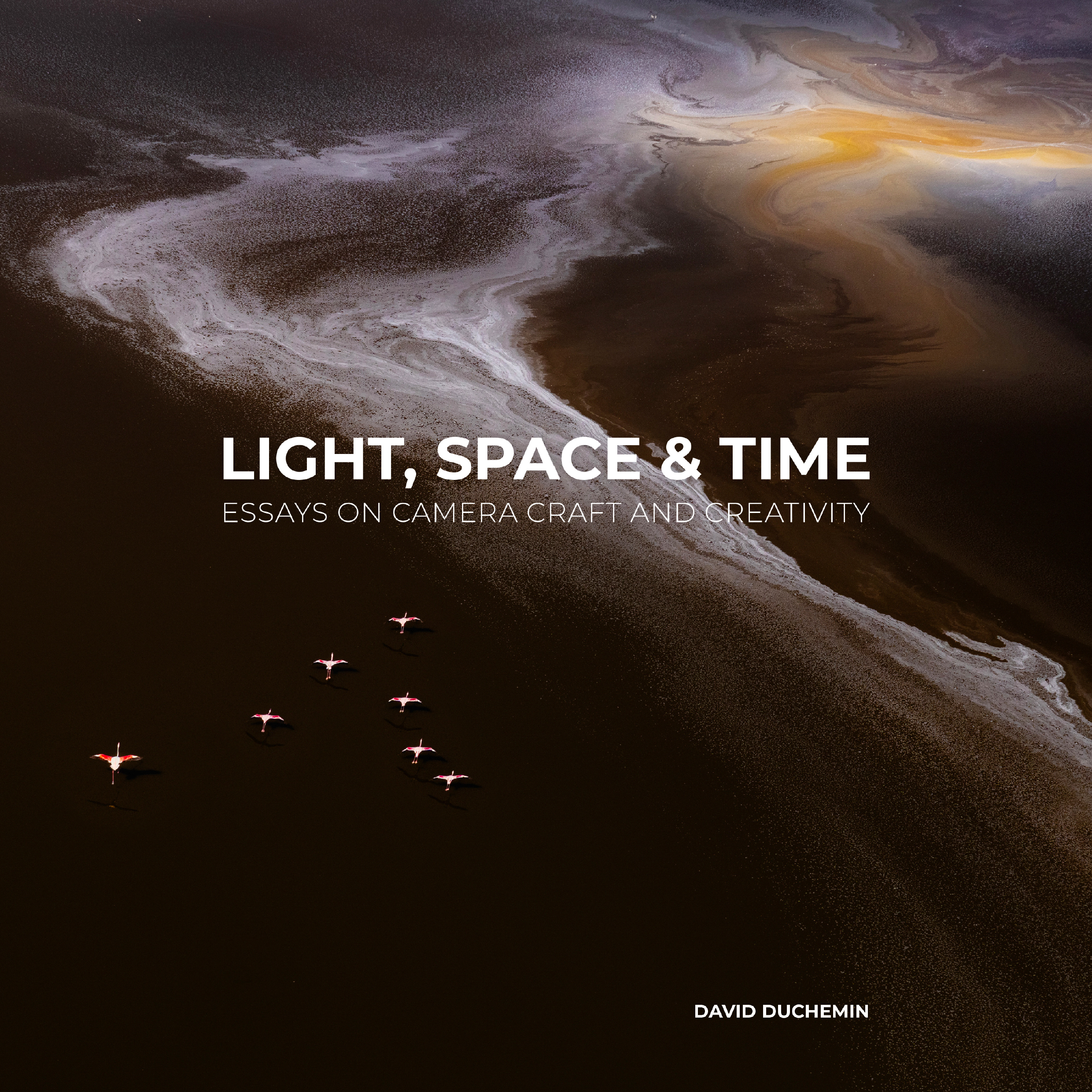
    The biggest challenges for most photographers are not technical but creative.  They are not so much what goes on in the camera but what goes on in the mind of the person wielding it.  Light, Space & Time is a book about thinking and feeling your way through making photographs that are not only good, but truly your own. It would make an amazing gift for the photographer in your life, especially if that’s you. Find out more on Amazon. 


    [ad_2]

    Source link

  • Change is Hard (At Least You Aren’t a Lobster)

    [ad_1]

    Something a little different for you this morning. 

    My heart stopped dead when I saw the black snake in my tent. Walking barefoot to the washroom in the middle of the night, my mind needed no time at all to jump to the certainty that what I was looking at was not just any snake but one of the most dangerous snakes in Africa—a black mamba. 

    I froze, very nearly freeing myself from the need to go all the way to the toilet to do that for which I’d awakened. My mind raced, my heart quickened, and my vision did that thing where everything goes blurry but then gets super-humanly sharp, which I guess is nature’s way of helping us deal with danger, to assess threat, and, in my case, to slowly realize that what I was looking at was not a black mamba, but the black camera strap I’d removed from my 600mm lens the day before. It must have fallen on the floor as I got ready for bed. God, I hate camera straps.

    I still like snakes, though. When I was a kid, I collected them. At one point, I had 30 snakes in my bedroom, all quite harmless. They lived in aquariums that I would buy at yard sales and kept from escaping—for the most part—with pieces of plywood across the top. Now and then, a snake would get out, and the woman who came in once a month to clean the house would burst into tears, threaten to quit, and never return. My mother would happily find the snakes, pick them up, and return them to their glass homes without blinking an eye and then, I’m certain, renegotiate our cleaner’s hourly rate.

    I kept the snakes for the summers and every fall, returned them to the woods and marshes where I found them, leaving behind half a dozen empty aquariums and, if I was lucky, some snake skins.

    Snakes, like many animals, shed their skins. In the case of snakes and lizards, what they leave behind is a husk—a ghostly structure from which they crawl. Humans also shed their skin, though we do it constantly, a few cells at a time, and not all at once on the bedroom floor, which is probably a blessing for a guy who gets freaked out by something as harmless as a camera strap. Can you imagine?

    Snakes shed their skin because they grow, and their skin does not. Lobsters experience the same thing. In order to grow, they molt, shedding their old shells and emerging with a new, soft one that hardens over time until it too is cast off, and the cycle repeats itself. Lobsters literally crawl out of themselves alive to grow. Meanwhile, I can’t even bring myself to throw out a favourite old t-shirt that no longer fits. Harder still to cast off habits or ways of thinking we’ve outgrown.

    So what does this have to do with your photography or creative life? The first lesson should be abundantly clear: don’t leave your camera straps lying around if you prefer not to piss yourself in the middle of the night. The second is a little more abstract: sometimes, you have to make wildly uncomfortable changes to accommodate the person you’re becoming or want to become. Big, scary changes. I can’t speak to the emotional life of the lobster, but I can’t imagine it feels great about leaving its armour behind and living without the comfort of that protection for the couple of weeks it takes for its new shell to harden.

    I wonder if the lobster even knows what’s going on. Does it understand these changes, or, like me, does it freak out, Google its symptoms, and assume the worst? In these moments of perceived calamity, is it certain that its world is never going to be the same or that the end is nigh? Does it go to the same dark places in its mind that I do in the middle of the night when I can’t sleep? Do snakes? Can you imagine crawling out of your own skin? And what do you do with the husk that’s left over? Is it garbage? Recycle? Does my municipality allow it in the organic waste bin? You could be grateful you’re not a lobster; they eat their discarded shells.

    Wow, this one got away from me quickly. Snakes? Lobsters? Sorry about that. Too much coffee this morning. I just wanted to remind you that change is hard. It’s uncomfortable and scary. It’s often the cost of moving forward in both life and art. And very often, it feels like failure. I doubt lizards and lobsters are as neurotic as we are; they simply do what they need to do to move forward and grow into their new selves. They don’t look back at their old selves with recrimination, the way we sometimes do, as if the person we once were could have (or should have) done the kind of work we do now. As if they should have known better or done better.

    Forward, ever forward, my friend. Change is necessary. Sometimes we grow and need to change to accommodate that forward momentum. Sometimes it’s the other way around, and we need to change to stimulate that growth. Sometimes it’s hard to know which is which, though I’m not sure that really matters. It only matters that we change, and it might help if we’re not so freaked out by it all. So often the thing we’re afraid of isn’t at all what we think it is. 

    For the Love of the Photograph,
    David


    [ad_2]

    Source link